

Extra-Inter-Intra
Why AI is a new type of disruption

Does history repeat? Does it rhyme? Or are some human developments so new and novel that we have no possible frame of reference for understanding them?
We tend to rely on history to understand the current moment. “Blood in the Machine” by technology journalist Brian Merchant does a painstaking job at unearthing lessons that can be learned from industrial automation in England’s textile industry.
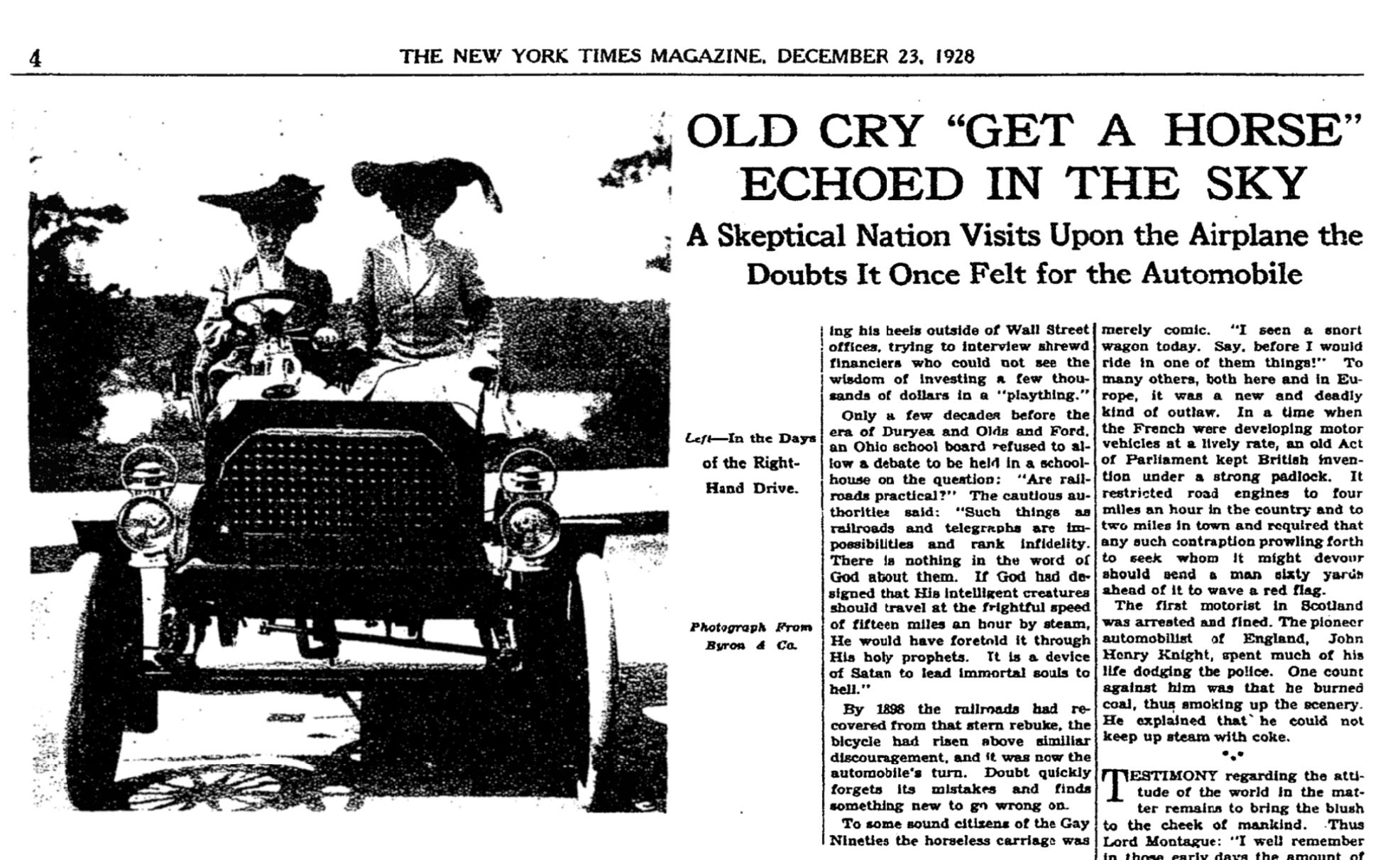
In my own work on autonomous vehicles, I found myself making arguments to skeptics that were made a hundred years ago to airplane and automobile opponents. As a side note, reading technology and society commentary from the early 20th century New York Times is a guilty pleasure of mine.
With AI, there is a view that historical analogies might be insufficient. And putting aside the economic hype around AI or doomerism around AGI, I agree that this time will be different. Here’s why:
The Industrial Revolution: A Revolution of Stuff
The industrial and globalization revolutions of the 19th and 20th centuries were extrapersonal disruptions. Factory automation, the Panama Canal, intermodal shipping, air travel - all of these things changed how physical things were created, connected, and moved in the world. So its impacts were largely economic. Certainly these had massive second order impacts on communities and individuals, but always rooted in how we related to each other as economic agents in the physical world.
The Information Revolution: A Revolution of Relationships
The information revolution of the late 20th and early 21st centuries, including PCs, mobile internet and social media, were interpersonal disruptions. They ultimately transformed our relationships to one another: what we see about each others’ lives (only the best parts now), how easily it is to communicate virtually from opposite sides of the world, what information we are exposed to in order to understand each other and our institutions. We are starting to learn how these disruptions have changed our communities, creating epidemics of loneliness, jealousy, anxiety, and political polarization.
The AI Revolution: A Revolution of the Soul?
Generative artificial Intelligence will cause intrapersonal disruptions - how we perceive ourselves, understand our own emotions, and decide to act on our thoughts and impulses. A dialogue with an AI chatbot is often thought to be an emulation of a chat with a friend or therapist. However, it’s more accurate to say it’s an emulation of your own internal dialogue. The ol’ angel or devil on your shoulder, made real. This is because your AI confidant isn’t part of your family or social circle and can’t communicate with others. There is a sense of absolute privacy that can induce individuals to divulge their deepest secrets or desires. If it weren’t for the resulting chatlog, your conversation might take place entirely in your head. An AI confidant can, with scalpel-like precision, adapt itself to our personality, our hopes, our dreams. And from that vantage point, it can also influence us profoundly. Who will you be with an AI companion ingrained in your life? Who would you have been without it?
We already see emerging results of this: the heartbreaking dialogue between a chatbot and a teen about to commit suicide. A previously impossible conversation between a man and his long dead father. The rise of a thing called *checks notes* AI psychosis!?!
In future posts I’ll plan to unpack this topic of intrapersonal disruption. What it means for the soul dividend in each of us will be vital to creating a framework for AI adoption that doesn’t result in an episode of Black Mirror.